
For many households, the kitchen is the heart of the home.
As one of the most important rooms in the house, your kitchen will naturally be one of the first rooms that you unpack.
Whether you’re unsure of the best way to unpack a kitchen or are simply searching for some tips for unpacking a kitchen, we’ve got you covered.
To unpack a kitchen after moving house, you will need to:
- Deep clean the kitchen
- Determine major work zones
- Begin unpacking large items first
- Unpack kitchen pots & pans next
- Decide the location for crockery, glasses, and kitchen utensils
- Unpack and arrange the pantry
- Safely store cleaning supplies
- Assign a Tupperware and plastic drawer
1. Deep Clean The Kitchen
First and foremost, before you unpack your kitchen, you’ll want to start off by deep cleaning the kitchen.
While the majority of previous owners will have left the house in a suitable condition, deep cleaning your kitchen is a must before packing anything away.
This will involve spraying the kitchen counters, and stovetop, and getting inside the oven, too. You’ll also need to dust and clean above the kitchen counters and the hard-to-reach areas that might have been missed by the previous owners.
This will provide you with the peace of mind that everything has been cleaned and sanitised before packing away your kitchen.
2. Determine Major Work Zones
Next, you will need to determine the major work zones in your kitchen before unpacking.
These zones will include cooking, prepping meals, and serving and entertaining to name a few.
For instance, for the cooking zone, you’ll want to unpack items such as pots, pans, and tools around the oven and stove. For prepping meals, you’ll want to unpack mixing bowls and measuring cups.
Write each major work zone clearly on a Post-it note before you begin unpacking boxes. This will indicate to everyone where everything needs to go.
This will keep things organised and prevent you from getting overwhelmed during the unpacking process.

You will want to determine the major work zones in your kitchen before unpacking.
3. Begin Unpacking Large Items First
Now you’ve done these steps, it’s time to begin unpacking large items first.
To begin, get your fridge and freezer in the right place and set up, as it will be much easier to unpack boxes without these large items in the way.
From your toaster to your kettle to rice cookers to coffee machines, you will likely have plenty of appliances to unpack and set up on the countertops.
Once these items are in place, you can begin unpacking your kitchen items.
4. Unpack Kitchen Pots & Pans Next
Following this, you can unpack kitchen pots and pans.
Whether you decide to store pots and pans in your kitchen cabinets or hang them up, make sure that they are all arranged in the cooking work zone we spoke about above.
Remember that it’ll be easier to unpack the larger pots and pans first, particularly if you intend to smaller pans inside them as a storage preference.
5. Decide The Location For Crockery, Glasses, & Kitchen Utensils
Next, you’ll need to decide the location for crockery, glasses and kitchen utensils.
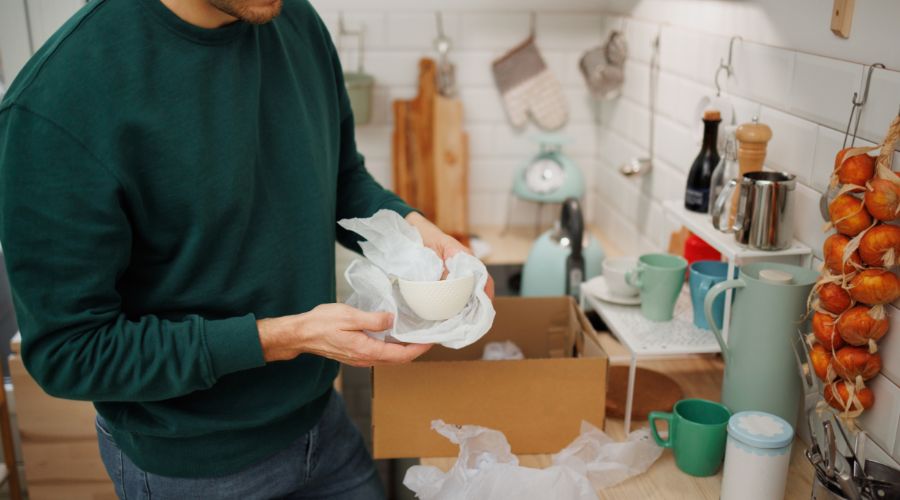
Once you’ve selected which cupboards will hold what, carefully remove the packing paper from the bowls, plates, and mugs and begin placing them into the correct places.
From wine glasses to tumblers to vases, carefully remove the bubble wrap that you used to wrap each of your precious glass items.
Now you can select convenient drawers to hold all of your kitchen utensils, from wooden spoons to kitchen cutlery.

Once you’ve selected which cupboards will hold what, carefully remove the packing paper from the bowls, plates, and mugs and begin placing them into the correct places.
6. Unpack & Arrange The Pantry
Next, you will need to unpack and arrange the pantry.
The pantry is where you’ll store your everyday cooking essentials and supplies, so it’s important to have a system in place.
Whichever way you decide to unpack, organise your jars, tins, spices, and other pantry essentials so that they can be easily seen and easy to access.
When you have a busy lifestyle, having an organised system in place is important to make cooking as simple as possible.
When you’ve finished, your pantry should be neat, tidy, and ready to be used.
7. Safely Store Cleaning Supplies
From detergents to cleaning products, you’ll need to find a safe place to safely store your cleaning supplies.
You should note that wherever you choose to store cleaning supplies, make sure that they are out of reach from small hands as ‘cleaning products remain a common source of poisoning for young children’. This also applies to keeping your pets safe from coming across dangerous chemicals, considering cleaning products can be harmful to pets.
Although children should never be left unattended, safely storing your cleaning supplies somewhere children and pets cannot access will help protect your loved ones.

You should note that wherever you choose to store cleaning supplies, make sure that they are out of reach from small hands as ‘cleaning products remain a common source of poisoning for young children’.
8. Assign A Tupperware & Plastic Drawer
Storing leftovers is so much easier with a collection of Tupperware.
As such, as a last step, you’ll want to assign a Tupperware and plastic drawer.
You can also store other plastic items here, from children’s cups to plastic plates to camping cutlery.
This will help to keep your crockery cupboards as neat and tidy as possible, as you’ll have a place specifically assigned for plastic items.
Hopefully after reading this article you now have a better understanding of how to unpack a kitchen after moving house.
To learn more about our removals services or purpose-built storage facilities, contact Nathan. At Falconers we use meticulous moving techniques, passed down and perfected through generations for over 132 years, to ensure your goods are moved with expert precision and kept in perfect condition. For more expert advice on how to pack, move and store your belongings — or other FAQs on how removals work — check out our blog page.
Written by Jemima Thomas for Falconer Removals & Storage.
